- September 22, 2026

-
-
Loading
Loading
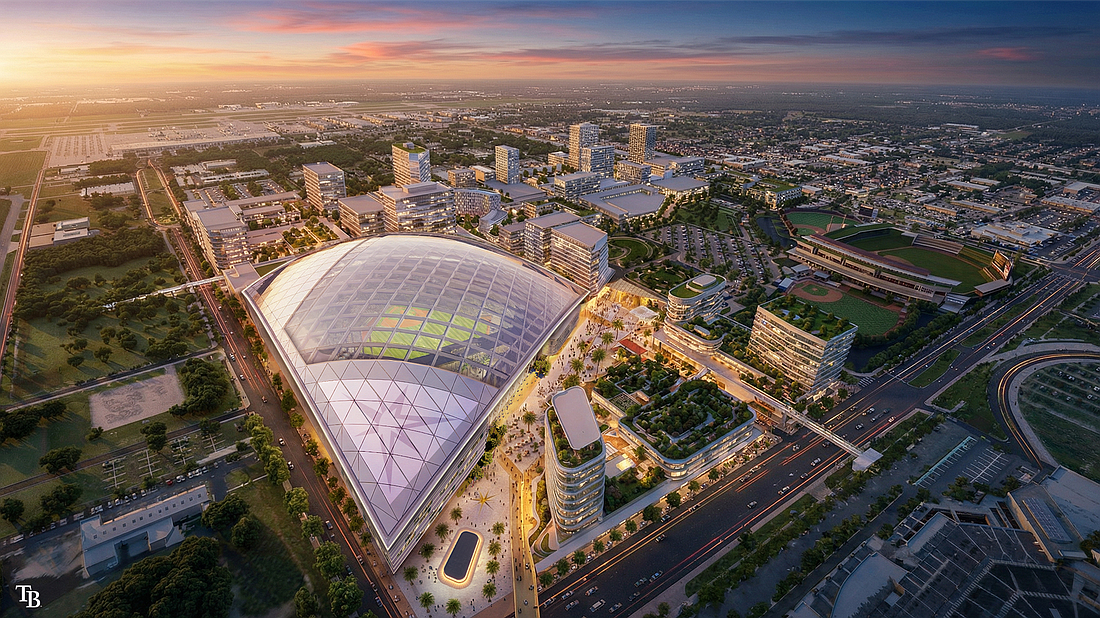
Tampa’s City Council took the first step Thursday in what could ultimately end the more than 20-year saga to build a new ballpark for the Tampa Bay Rays.
The council, at the end of a nearly seven-hour discussion, voted 4-3 to approve its $80 million portion of the funding for a new $2.3 billion stadium to be built on Dale Mabry Highway on the site of Hillsborough College and across from Raymond James Stadium.
Council members Alan Clendenin, Bill Carlson, Naya Young and Luis Viera voted for the funding. Charlie Miranda, Guido Maniscalco and Lynn Hurtak voted against it.
The Hillsborough County Commission will vote on its $796 million portion of the funding and to finalize the agreement Friday.
If the team prevails on that vote, construction work on the project could begin as soon as this fall.
The Rays' stadium plan calls for spending $2.3 billion to build the ballpark on the site of the college. The team has committed to put $1.3 billion of its own money into the stadium and absorb any cost overruns.
The team, if the county approves its portion of the funding, will commit to play at the stadium for 35 years and pay $4 million a year in rent.
The plan also calls for the eventual construction of multi-use development to include hospitality, retail and dining options as well as a new campus, on the property, for Hillsborough College.
The city’s portion for the stadium is $80 million and, according to the agreement between the government entities and the team, will be paid out over four installments. The first $20 million payment is due Jan. 1, the second Oct. 1. The remaining two payments are due October 2028 and 2029.
According to the team and council, the city will recoup the money, which will likely be borrowed, over time through property tax revenue. And it will benefit from the infrastructure to be built around the stadium.
Tampa’s portion of the funding is far less than was originally called for when a memorandum of understanding between the city, county and team was announced in May.
In that agreement, the city, through its Community Redevelopment Agency would have contributed an additional $100 million for the ballpark.
But city council members balked and rather than abandoning the deal the Rays agreed to “form a special-purpose vehicle to privately place $100 million of taxable bond, notes or other indebtedness.”
The team will also create a Community Development District to oversee the public infrastructure and community amenities in the project.
Carlson, who was instrumental in reworking the agreement after threatening to oppose a final deal when negotiations were approved in May, repeatedly said Thursday that the city’s money was not going to the Rays or its ownership but to projects city residents will benefit from.
“I’ve had a bunch of people ask me, ‘Why did you change your mind?’” he said. “And the fact is, I didn't change my mind. The deal changed.”
Young said her decision to approve the plan was about how the stadium project would affect the community. She said that after extensive conversations with the Rays ownership and city staff, she is convinced that even with the $80 million price tag, the project will be a net positive across the city.
“This deal is not perfect. I think we all can admit that,” she said.
“But what I do see is opportunity. I see opportunity for our youth, not just kindergarten through 12th grade, but our college students as well. I see opportunity for our youth sports and facilities.”
If county commissioners follow the city in approving the agreement, it could finally end what has been a process that has seen twist and turns worthy of Agatha Christie in her prime.
The Rays previous ownership, after years of discussing the need for a new ballpark and several false starts, announced in 2018 plans for an $892 million-dollar stadium in Ybor City.
It failed.
That was followed in 2022 by a plan for the team to play half its games in Tampa or St. Petersburg and half in Montreal. A new stadium would have been built in each city and the Rays would have alternated cities each year for the playoffs.
Major League Baseball’s executive committee rejected the plan.
A year later, then-Tampa Bay Rays owner Stuart Sternberg and St. Petersburg Mayor Ken Welch announced a deal for a new $1.3 billion ballpark in the city on the site of Tropicana Field. It was tied to the $6.5 billion redevelopment of the Historic Gas Plant District.
But in March 2025, after winning city and Pinellas County approvals for the funding, Sternberg announced that the cost of building the stadium was getting too high for the team to meet its share — $600 million plus the cost overruns.
The Rays killed the deal.
The new ownership group, which bought the team later in the year, committed from the first day to build a new ballpark for the team that would open in time for the 2029 season in Tampa.
Commissioners are scheduled to meet at 9 a.m. Friday.