- December 13, 2025

-
-
Loading
Loading

Segregation and Jim Crow laws have been justifiably relegated to the trash bin of U.S. history, but their specters remain present in some of the country’s built environment. Case in point: Tampa’s Union Station, which opened in 1912 and was constructed in a gorgeous Italian Renaissance Revival style. But it also had a wall that segregated passengers according to their skin color.
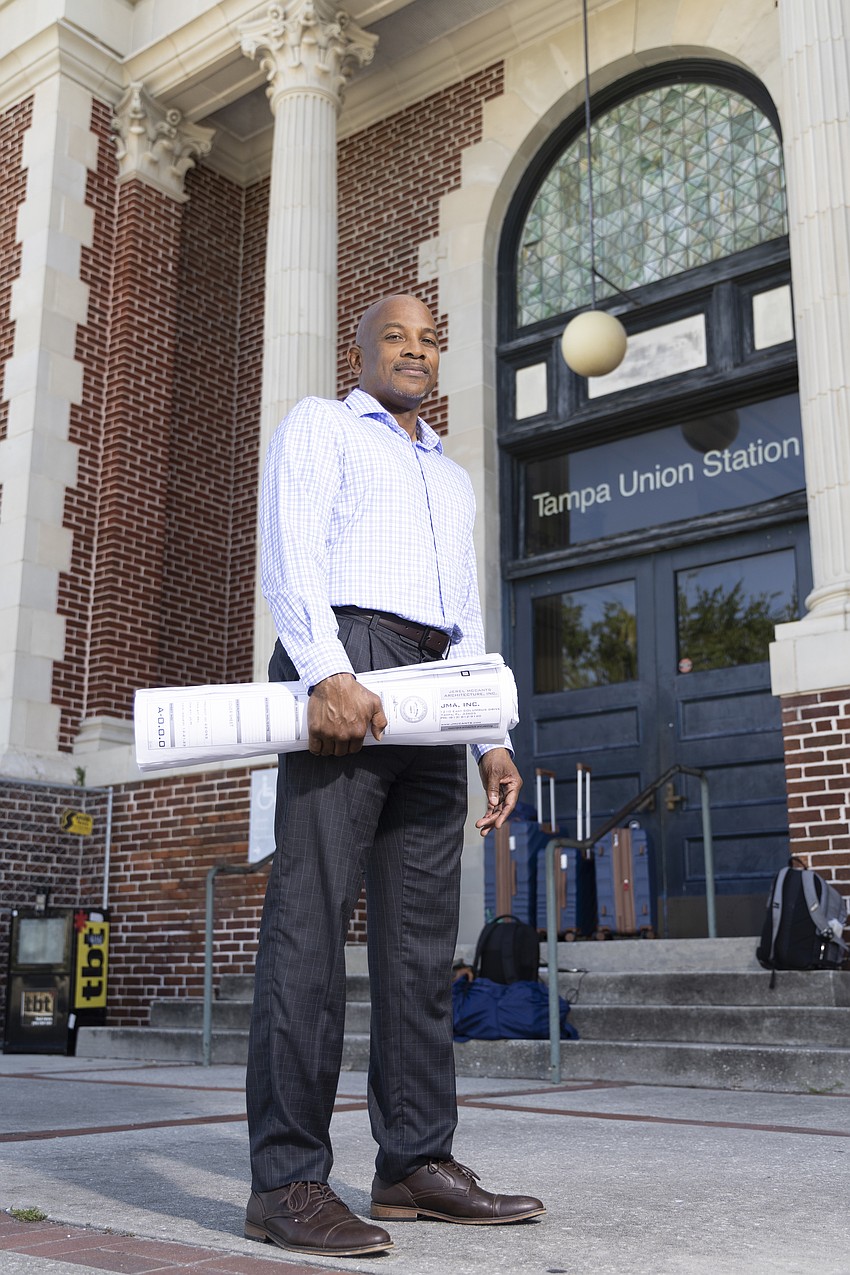
“The wall was about eight to 10 feet tall,” says Jerel McCants, a Tampa architect whose firm, Jerel McCants Architecture Inc., is leading a $6 million restoration of the station. “There were separate water fountains on both sides. There were separate ticket counters, separate bathrooms. The left side was colored; the right side was whites only.”
Yet once the train arrived, all passengers exited into an open communal embarkation space, where everyone mixed, proving that “separate but equal” policies weren’t about pragmatic use of space.
“It made no sense,” says McCants, who also serves as vice president of Friends of Tampa Union Station, a nonprofit formed in 2008 to preserve the historic building. “It doesn’t hold up to any scrutiny.”
Tampa isn’t the only city reckoning with the injustices of its built environment. In Lexington, Kentucky, to cite one example, the 155-year-old Capitol has come under fire for its “bathroom disparity.” The Kentucky Statehouse’s third floor, home to the state’s House and Senate chambers, offers a measly two bathroom stalls for the Bluegrass State’s 41 female legislators, while restrooms for men are plentiful. A $300 million renovation project for that facility is underway, expected to be finished in 2028.
McCants, 52, has written and published a book, Architecture of Segregation: The Hierarchy of Spaces and Places, about how the built environment can reinforce but also break down societal divisions. He says he’s always been fascinated by public spaces and how people interact with them, but conversations with his grandfather during his formative years inspired him to think more critically about the social underpinnings of architecture.
“He would talk about how he grew up and places where he could go and couldn't go,” McCants says. “He had to go through the back door of some places. If he was sick and had to go to the doctor, the white patients would be seen first, and then they would get around to seeing the Black patients later.”
He adds, “That wasn’t my experience growing up, but it stuck with me through my developmental years.”
The Union Station overhaul, according to McCants, should be complete in early 2027, but the station, he says, “will remain functional while renovations are going on.” The building — which fell into disrepair in the 1970s and ’80s, closing to the public in 1984 as interstate and air travel eclipsed rail — was previously renovated in 1998 to make it a viable Amtrak depot once again. Other modest upgrades, such as a 2002 restoration of the station’s baggage building, followed, but the notorious wall remained.
The new and improved Union Station, McCants adds, won’t ignore or downplay the building’s checkered past.
“We have some signage and placards [from that era],” he says. “We might do a little artifact box. We have old photos and drawings that we might mount on the walls where passengers wait.”
For Jerel McCants Architecture Inc. — which was founded in 2010, grossed $1.5 million in revenue in 2024 and has seven employees, including four architects — Tampa Union Station is somewhat of an outlier in the firm’s portfolio: It mostly does new commercial and residential builds. Some of its previous projects include St. Petersburg’s Par Bar, 81Bay Brewing Co. in South Tampa, Taps Restaurant, Bar & Lounge in Fort Lauderdale, and CTV Capital headquarters in New Port Richey.
McCants, however, says his favorite projects are residential in nature: “Residential, even though it doesn't make a lot of money, it’s always a unique building type, because it's the only place where you can live comfortably, work and entertain, all in the same structure. You don’t want to live in your office, your church, your community center, or other spaces that have a defined use. The house is the most flexible of all uses to me, and so they are the most interesting [to design].”